
Walter Writes pricing: is the Pro plan worth it for content teams?

Last quarter, my CEO asked me to pull together a list of every tool my team pays for. Pretty standard stuff for a growth-stage startup tightening its budget. I got to Walter Writes pricing and sat with it longer than anything else.
Not because I couldn’t justify it.
Because I’d never written the justification down. And in my market, that answer matters more than the number.
We sell AI tutoring software to higher education institutions. Our buyers are provosts, academic technology officers, faculty governance committees. If they find AI-generated content in our marketing, we don’t just lose a deal. We lose credibility in a room that took years to earn access to. The bar I hold my team to isn’t “passes a quick scan.” It’s “a skeptical faculty committee could read this and find nothing to question.”
That’s the lens for this. It might also be useful if you manage content for any audience that actually checks.
Walter Writes pricing runs $96/year for Starter (30,000 words/month), $156/year for Pro (70,000 words), and $312/year for Elite (200,000 words). Teams with real production volume typically end up at Pro. At $13/month, it gives enough capacity to run humanization and detection without rationing requests or splitting drafts mid-sprint.
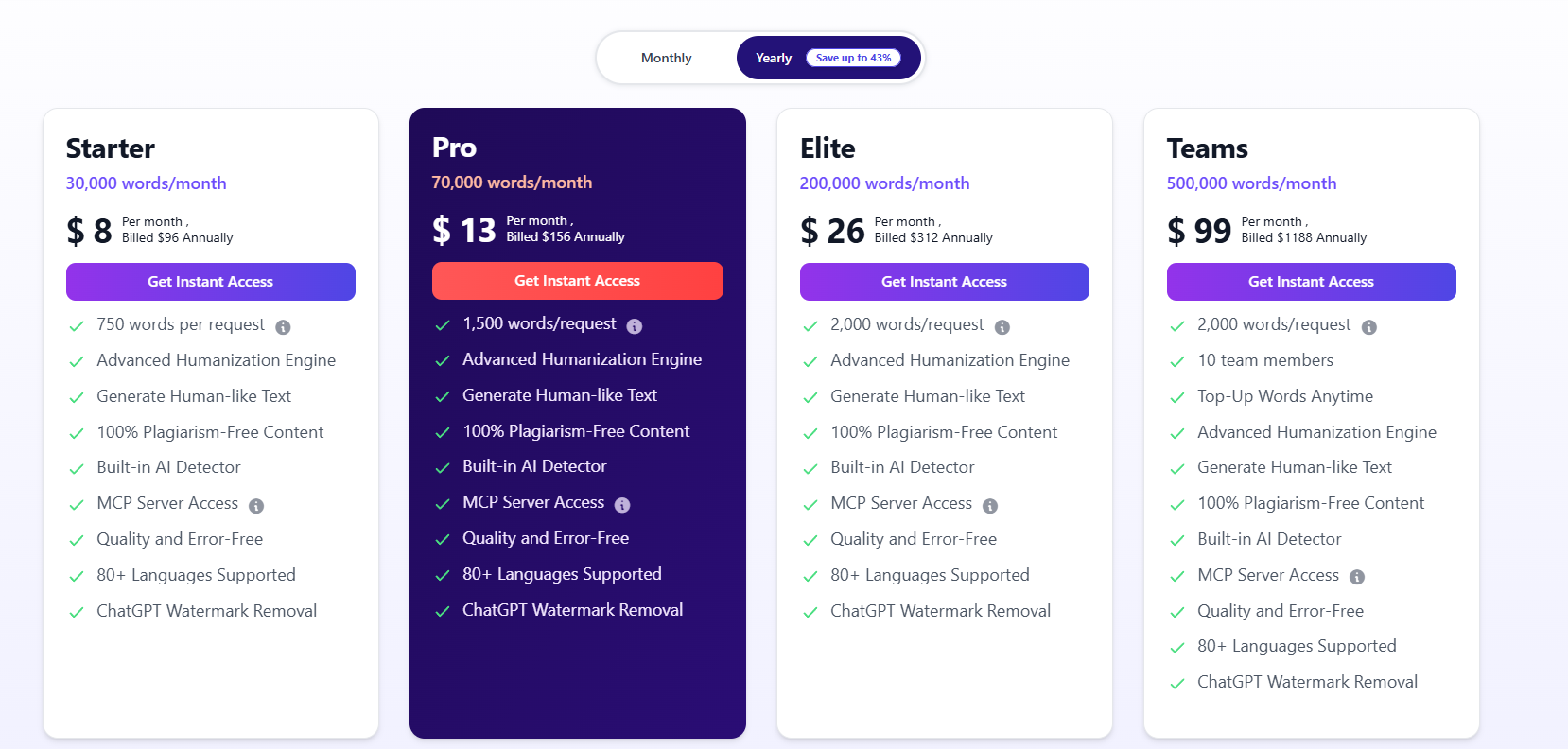
What the Walter Writes pricing tiers actually look like
Annual billing only, as far as I can tell. No monthly option listed. Worth knowing if your finance process needs a monthly line item.
Free: 300 words, one-time. No login. Test the output quality before you commit to anything.
Starter: $96/year ($8/month). 30,000 words/month, 750 words/request.
Pro: $156/year ($13/month). 70,000 words/month, 1,500 words/request.
Elite: $312/year ($26/month). 200,000 words/month, 2,000 words/request.
Teams: $1,188/year. 500,000 words/month, 2,000 words/request, 10 members.
The jump I’d focus on is Starter to Pro. Monthly volume more than doubles. The request cap doubles too. 750 words versus 1,500 words per request. That’s what actually changes day-to-day production.
A typical 1,200-word B2B piece clears the Pro limit in one pass. On Starter, you’re splitting it and running two separate requests. Not technically broken. What it does, though, is add friction at exactly the moment when friction does the most damage. I’ve watched a writer skip the QA step because it felt like too many clicks. The tool didn’t fail. The process did, because the workflow gave her an exit ramp.
Teams of three to five can usually run a single Pro account with shared credentials and cover the workload. The Teams plan is really for when you need separate logins, admin visibility, or user-level reporting.
Is the Walter Writes paid plan worth it for a content team?
Here’s the tension: Starter sounds completely reasonable until you try running a real editorial calendar through it.
My team produces eight to twelve long-form pieces per month. That’s before counting thought leadership drafts, email sequences, or the occasional piece my CEO hands off for a QA pass. At 30,000 words a month, we’d be rationing by week three. Pro at 70,000 words makes QA a routine step instead of a scheduling decision. That alone is worth the difference in price.
But the word count isn’t what I pay for. It’s the detector.
Walter Writes combines humanization and detection in the same editor. Paste a draft, run the rewrite, and the AI-likelihood score is right there. No second tab, no export step, no moving between tools. My team has three writers with three very different relationships to AI. One uses it carefully. One over-relies on it. The detection score after humanization shows me what the final draft looks like before it reaches my desk, not after.
I wrote about this workflow in why I use two tools on every draft. The core point: humanization and detection aren’t two separate steps. They’re one. Treating them as separate is exactly where QA breaks down. A tool that keeps them together removes one more decision from a writer already moving fast.
The paid plan is what makes that combination work at production scale. The free tier is a test drive.
Walter Writes cost: what you’re actually paying per piece
Pro is $156/year. $13/month. My team runs about ten long-form pieces through QA a month, so cost per piece is $1.30.
Running a separate humanizer and a separate detector means paying for two tools to do one job. Most comparable products price those functions independently, so the real cost is at minimum double before you even count the friction of moving between tools.
That said, the comparison I keep returning to isn’t tool versus tool.
It’s tool cost versus incident cost.
In EdTech specifically, a deal that doesn’t close because a procurement committee ran a detector on our blog content is completely invisible in any attribution model. It won’t show up as “lost to AI content concern.” It just won’t close. I covered the structural version of this in I work for an AI company. My buyers distrust AI.
$13/month isn’t a budget I fight for. I approved it in under five minutes.
This is the actual problem with how most content teams evaluate tool costs: the subscription gets weighed against the features, not against the risk the tool is protecting against. Once you change the denominator, the math looks very different.
Is Walter Writes worth it in 2026?
I keep coming back to this because the landscape two years ago isn’t the same now. The tools that were holding up in 2024 aren’t clearing the same bar against current detection models.
Most early humanizers swapped synonyms. Swap enough words, lower the score. Detection has caught up to that. Shallow word replacement doesn’t hold. Walter Writes rewrites at the structural level, not just the vocabulary. The way ideas are structured and expressed, not just the words used to express them. That produces output that reads differently to a human reviewer, not just to a detector.
My buyers are among the most AI-literate audiences in B2B. A piece that dodges a detection score but still reads like machine output doesn’t clear my bar. That’s the distinction that matters for me.
There are three adjustable rewrite levels: Simple, Standard, Enhanced. I run most external content at Standard. Anything touching our academic integrity positioning goes to Enhanced. That granularity wasn’t something I expected to use as often as I do, but it ends up on almost every significant piece.
For comparison, Undetectable AI comes up often. As a solo tool for light-volume work, it holds up. No built-in detection, though, and it’s not built for team production. I evaluated it before settling on Walter Writes, and the closed-loop editing experience wasn’t there. That was the deciding factor, not price.
For lower-volume individual use, TextHumanizer and EssayHumanizer AI are accessible starting points. They’re low-friction and low-commitment. A team operating under real brand exposure with institutional buyers needs something that carries more weight.
Is Walter Writes worth it in 2026? Yes, if AI credibility is a genuine risk in your market. If your audience doesn’t check, almost anything works. Mine checks.
What I tell my team
The tool doesn’t solve the problem. It shows you where the problem still exists.
A 90% human score isn’t a pass at my team. It’s a signal that something still needs work. My internal threshold is 95% before anything comes to my desk for final review. That rule came from writing down what my actual QA process looks like for the first time, after I realized I was enforcing an undocumented standard across three writers who were each interpreting it differently.
Nobody said this out loud but QA processes that fail in content teams almost never fail because the tool is bad. They fail because the standard is invisible. A writer who doesn’t know the threshold will guess. And guessing with AI content, in a market where buyers run detectors, is a brand liability that won’t surface anywhere until it’s already cost you something.
Pro gives us enough volume to run that standard on every piece, every month, without rationing. Not the features. The consistency it makes possible. That’s what I bought it for.
FAQ
Is Walter Writes AI paid?
There’s a free tier, but it’s a one-time 300-word trial. No login required, which makes it genuinely useful for testing before committing. For ongoing production, yes, it’s paid. Starter starts at $96/year ($8/month billed annually).
What’s the difference between the Starter and Pro plan?
Volume and request size. Starter: 30,000 words/month, 750 words/request. Pro: 70,000 words/month, 1,500 words/request.
For occasional solo use, Starter might be enough. Running a content team’s output through QA consistently, though, and the request cap becomes a production bottleneck. Pro removes it at $13/month. That’s the number where QA becomes a standard instead of a judgment call about what gets checked this week.
Is Walter Writes worth it compared to free alternatives?
Free alternatives are fine for low-stakes individual use. For a team with real brand exposure, the gap is detection. Walter Writes bundles humanization and detection in one editor. Replicating that with two separate free tools adds friction and usually still costs money on the detection side. If consistency matters, Pro is more defensible.
How does Walter Writes pricing compare to the market?
Mid-range for humanizer tools overall, below average once you factor in that detection is bundled in. Most comparable tools charge separately for that. At $156/year for Pro, it’s one of the more affordable full-stack options. The Teams plan at $1,188/year for 10 members comes out to roughly $10/user/month, which is competitive against per-seat tools that don’t bundle detection.
Content teams in my world don’t get to make the case for quality in the abstract. They make it in budget reviews, against volume targets, with procurement cycles that run 9 to 18 months and attribution models that can’t track a deal that never formally died.
Walter Writes pricing, at the Pro tier, is the answer I gave my CEO. It’s the answer I’d give any content manager whose buyers are the kind of people who check.